
 Written by:
Louise is an SEO Writer for Spacer Technology, creating content for the Parkhound, WhereiPark, Spacer.com.au, and Spacer.com brands. Before joining Spacer, Louise wrote copies and blogs, news, retirement and financial education content. She is enthusiastic about reinforcing financial literacy and anything that can aid people in minimizing expenses and maximizing savings, which led to her passion for the sharing economy. She aims to educate people by translating complex ideas into easy-to-digest information and practical tips for maximum understanding and minimum migraine.
 Edited by:
Zarah Mae Torrazo leads the content team for Parkhound, WhereiPark, Spacer.com.au, and Spacer.com, where she focuses on helping drivers navigate city-specific parking rules, street regulations, and reliable monthly parking options across major North American and Australian markets. With nearly a decade of experience in research-driven content, she translates complex local parking policies into clear, practical guidance that helps people find safe, affordable spaces wherever they’re headed. Her work draws on a deep understanding of how urban parking systems operate and how shared parking solutions can support both drivers and communities.
Learn what a parking brake is, how it works, and when to use it. This beginner-friendly guide helps new drivers stay safe, protect their vehicle, and build good driving habits.
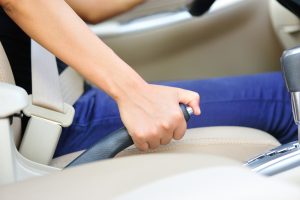
The parking brake is one of the simplest but most important safety features in any vehicle, and using it correctly is a key part of safe driving. Understanding how the parking brake works can help prevent rollaways and reduce strain on your transmission, especially when parking uphill, stopping briefly on an incline, or simply securing your car in crowded areas and parking lots.
New drivers often overlook the parking brake because automatic transmissions feel stable on their own, but neglecting to engage it may cause unintended harm to both people and property.
In fact, agencies such as the National Highway Traffic Safety Administration (NHTSA) and organizations like AAA recommend its regular use to keep your vehicle secure, ensure child safety, and to maintain good driving habits from the start.
A parking brake, also called emergency brake, handbrake, or e-brake, is a secondary braking system that helps keep your vehicle from moving when it is parked. Unlike the main hydraulic brakes you use while driving, the parking brake works independently and is designed to hold the car in place by locking the rear wheels. This provides added security, especially when the vehicle is stopped on uneven surfaces or steep inclines.
Modern vehicles may use different mechanisms to activate it, and the parking brake’s location varies depending on the vehicle. In many older or traditional models, you may find a hand-operated lever between the front seats while some vehicles use a foot pedal positioned to the far left of the driver’s footwell.
Newer cars often feature an electronic parking brake in the form of a small switch or button, and it can usually be found near the center console or dashboard. Regardless of the form and location, all parking brake versions have the same purpose of keeping your vehicle securely in place when engaged.
A parking brake works by creating a mechanical hold on your vehicle’s rear wheels which prevents them from turning. In traditional systems, pulling the lever or pressing the pedal tightens a steel cable connected to the rear brakes, and this tension forces the brake pads against the drum or rotor. This locks the wheels in place even when the hydraulic brake system is not active.
As for electronic parking brakes, these use small electric motors controlled by a switch or button instead of a physical cable. When the system is engaged, the motors apply pressure to the rear brakes automatically. Many electronic versions also include features like auto-hold, which engages the brake when the car is stopped in traffic, and automatic release, which disengages it when you press the accelerator.
Despite the systems’ differences, both traditional and electronic systems secure the rear wheels to keep the vehicle stays stationary and reduce the risk of a rollaway when properly engaged.
Using the parking brake is an important habit that keeps your vehicle secure and reduces wear on the transmission, and it should be used in more situations than many new drivers realize. Here are the most common times to use it:
Everyday driving situations
You should use the parking brake anytime you park your vehicle, regardless of whether the surface is flat or sloped. Using it regularly keeps the mechanism in good working condition and adds an extra layer of safety, so always engage the parking brake when:
Safety and emergency use
The parking brake provides an emergency option if something goes wrong since it operates independently of the hydraulic brake system. Use it:
Transmission considerations
Your vehicle’s transmission type can influence how often you should rely on the parking brake.
Rental cars and unfamiliar vehicles
Different regions and models use levers, pedals, or electronic switches, so being familiar with the system helps ensure safe and confident operation. Be sure to:
Using the parking brake regularly builds safe habits and helps keep your vehicle secure in a wide range of situations, no matter what country you’re in.
Using the parking brake regularly is a simple habit that’s necessary for long-term vehicle maintenance and safety. Regular use of the parking brake helps ensure that the system stays functional and prevents avoidable strain on your transmission, especially as the vehicle ages. Likewise, engaging the parking brake reduces the risk of unexpected movement, which helps protect your vehicle from receiving damage or causing accidents to people and property.
No matter the type, transmission, and age of the vehicle you use, relying on the parking brake is an easy way to stay secure and confident behind the wheel.
Louise is an SEO Writer for Spacer Technology, creating content for the Parkhound, WhereiPark, Spacer.com.au, and Spacer.com brands. Before joining Spacer, Louise wrote copies and blogs, news, retirement and financial education content. She is enthusiastic about reinforcing financial literacy and anything that can aid people in minimizing expenses and maximizing savings, which led to her passion for the sharing economy. She aims to educate people by translating complex ideas into easy-to-digest information and practical tips for maximum understanding and minimum migraine.
Louise is an SEO Writer for Spacer Technology, creating content for the Parkhound, WhereiPark, Spacer.com.au, and Spacer.com brands. Before joining Spacer, Louise wrote copies and blogs, news, retirement and financial education content. She is enthusiastic about reinforcing financial literacy and anything that can aid people in minimizing expenses and maximizing savings, which led to her passion for the sharing economy. She aims to educate people by translating complex ideas into easy-to-digest information and practical tips for maximum understanding and minimum migraine.
This will close in 0 seconds
This will close in 0 seconds