
 Written by:
Zarah Mae Torrazo leads the content team for Parkhound, WhereiPark, Spacer.com.au, and Spacer.com, where she focuses on helping drivers navigate city-specific parking rules, street regulations, and reliable monthly parking options across major North American and Australian markets. With nearly a decade of experience in research-driven content, she translates complex local parking policies into clear, practical guidance that helps people find safe, affordable spaces wherever they’re headed. Her work draws on a deep understanding of how urban parking systems operate and how shared parking solutions can support both drivers and communities.
 Edited by:
Louise is an SEO Writer for Spacer Technology, creating content for the Parkhound, WhereiPark, Spacer.com.au, and Spacer.com brands. Before joining Spacer, Louise wrote copies and blogs, news, retirement and financial education content. She is enthusiastic about reinforcing financial literacy and anything that can aid people in minimizing expenses and maximizing savings, which led to her passion for the sharing economy. She aims to educate people by translating complex ideas into easy-to-digest information and practical tips for maximum understanding and minimum migraine.
Double parking is when a vehicle stops or parks next to another car that’s already parked, blocking other vehicles or part of the roadway.
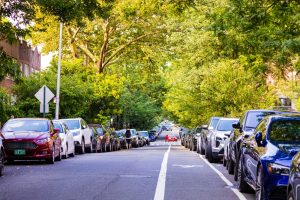
It’s usually illegal in most U.S. and Canadian cities because it disrupts traffic and prevents other drivers from moving safely. And its a big problem for most cities. For instance, New York City issued 336,000 tickets for double parking in 2024 alone.
This article helps drivers understand the rules around double parking, why it’s prohibited in most places, and how to avoid parking tickets or accidents by parking correctly. If you need a reliable place to park, Spacer connects drivers with verified parking spots across the U.S. and Canada.
Spacer is your easy solution. It’s cheaper to pay for a short-term parking space than to risk a $100+ double-parking ticket.
Browse Spacer for secure, affordable spots listed by locals and book in minutes.
Before you start thinking double parking is just a fancier way to say parallel parking, they’re actually two very different things. One is a proper, legal way to park along the curb, while the other can land you a ticket (or get your vehicle towed) if you’re not careful.
Parallel parking is a standard, legal parking technique. You find a space along the curb (or parallel to the roadway), signal, align your vehicle, and park between two vehicles (or between the front and back boundaries) so that your car is properly within the space.
For example, the New York State Department of Motor Vehicles manual describes how to select a parking space large enough, stop adjacent to the vehicle ahead, back in, and straighten the wheels.
Double parking is not about technique so much as violation. The Merriam-Webster dictionary defines it as “to park (a vehicle) beside a row of vehicles already parked parallel to the curb.”
It means the vehicle is stopped or parked beside a legally parked car (or in a way that blocks a lane) in such a way that it obstructs traffic or prevents another vehicle from moving.
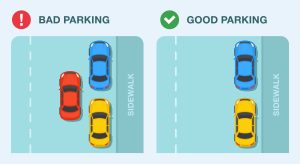
Legitimate space versus illegitimate occupation. Parallel parking is intentional, legal, and within bounds. Double parking is an improper use of space (often the travel lane).
Traffic flow: Parallel parking aims to coexist with the existing flow. On the other hand, double parking disrupts traffic as it blocks lanes, hindering exits, or creating hazards.
Location and clearance: With parallel parking, your car fits neatly within a marked space along the curb. Double parking means stopping in the lane adjacent to those parked cars, blocking part of the road where vehicles are supposed to drive.
In most U.S. and Canadian cities, traffic codes classify double parking as a violation for a few key reasons:
Double parking is prohibited in every major U.S. city under municipal traffic codes. Fines vary by location but typically range from $70 to $150 depending on severity, obstruction, and towing risk.
| City | Legal Reference | Typical Fine | Notes |
| New York City, NY | NYC Traffic Rules §4-08(e) | $115 | Strict enforcement. Parking ticket issued even if the driver remains in the vehicle. |
| Los Angeles, CA | LAMC §80.69(a) | $93 | Illegal to park or stop on the roadway side of another vehicle. |
| Chicago, IL | Municipal Code of Chicago §9-64-090 | $150 | Applies to both attended and unattended vehicles; may include towing. |
| San Francisco, CA | California Vehicle Code §22500(h) | $110 | Immediate ticket; may be towed if obstructing a travel lane. |
| Houston, TX | City Code §26-92 | $70 | No stopping beside a parked vehicle; enforced downtown. |
| Philadelphia, PA | Philadelphia Code §12-913(2) | $75 | Prohibits parking on the roadway side of another vehicle. |
| Dallas, TX | Dallas City Code §28-87 | $80 | Double parking considered obstruction of traffic; fine varies by district. |
| San Diego, CA | Municipal Code §86.27 | $100 | Illegal to stop, stand, or park on roadway side of a parked vehicle. |
| Phoenix, AZ | City Code §36-137 | $75 | Unlawful to park on the roadway side of another vehicle or block traffic flow. |
| San Antonio, TX | Code of Ordinances §19-259 | $75 | Cited under “obstructing traffic lane”; fine varies by zone. |
Disclaimer: The information above reflects city ordinances and fine amounts accurate at the time of writing. Parking rules and penalties can change, so always check your local traffic code or municipal website for the most up-to-date regulations in your city, county, or township.
Like the U.S., every major Canadian city enforces municipal by-laws that prohibit stopping or parking beside another vehicle.
| City | Legal Reference | Typical Fine | Notes |
| Toronto, ON | City of Toronto Parking By-law 199-2014 | $100–$150 | Enforced under “Obstructing traffic” provisions; ticket and towing possible. |
| Vancouver, BC | Street and Traffic By-law No. 2849 §17.1 | $100 | Prohibits parking on the roadway side of another vehicle. |
| Montréal, QC | Règlement sur le stationnement (CA-17) | $150 | Double parking prohibited; fines may double on snow routes. |
| Calgary, AB | Traffic Bylaw 26M96 §27(1) | $68 | Illegal to park on the roadway side of another vehicle; ticketed by Calgary Parking Authority. |
| Ottawa, ON | Traffic and Parking By-law 2017-301 §59 | $100 | Defines double parking as stopping beside a parked vehicle; enforced by by-law officers. |
Disclaimer: The fine amounts, by‐law references and definitions listed here are accurate at the time of writing but may change. Always check your local municipality, town or regional by-law for the most up-to-date regulations in your area.
Drivers often misunderstand what counts as double parking. Here are some common misconceptions and what the law actually says in most cities.
| Misconception | Reality |
| “I’m just stopping for a minute.” | Even short stops count as double parking if you’re beside another parked car or in an active lane. Most cities define “parking” as any stop that isn’t for traffic control or an emergency. |
| “Hazard lights make it okay.” | Turning on your hazards doesn’t make it legal. The lights are meant to warn others, not excuse blocking a lane or parked vehicle. Officers can still issue a ticket even if your lights are on. |
| “I didn’t see any signs.” | Double parking doesn’t need a sign to be illegal. It’s treated as a traffic obstruction under most city codes, so signage isn’t required. |
| “I stayed in the car, so it’s fine.” | Staying behind the wheel doesn’t change the rule. If your vehicle blocks traffic or prevents another driver from leaving, it’s still double parking. |
| “It’s okay if it’s a quick delivery or drop-off.” | Delivery and rideshare drivers must still use legal loading zones. Stopping in a travel lane, even briefly, can result in a citation unless a valid permit or exception applies. |
Planning ahead and knowing your local parking options can save you from costly tickets or tows. These quick practices help you stay on the right side of parking laws:
Related: City parking guides for Los Angeles, Downtown San Francisco, and Boston.
Double parking might seem harmless or convenient, but it creates safety risks, slows traffic, and violates city laws. Choosing legal spaces helps keep streets safer and reduces congestion for everyone on the road.
Responsible parking starts with planning ahead and respecting local rules. A few extra minutes to find a proper space can save you from fines and frustration.
Need a quick stop or a reliable spot in a busy area? Spacer connects drivers with verified parking spaces near offices, apartments, and transit hubs. Choose from garages, driveways, and private lots offered by trusted local hosts, so you can park legally, conveniently, and without stress.
Zarah Mae Torrazo leads the content team for Parkhound, WhereiPark, Spacer.com.au, and Spacer.com, where she focuses on helping drivers navigate city-specific parking rules, street regulations, and reliable monthly parking options across major North American and Australian markets. With nearly a decade of experience in research-driven content, she translates complex local parking policies into clear, practical guidance that helps people find safe, affordable spaces wherever they’re headed. Her work draws on a deep understanding of how urban parking systems operate and how shared parking solutions can support both drivers and communities.
Zarah Mae Torrazo leads the content team for Parkhound, WhereiPark, Spacer.com.au, and Spacer.com, where she focuses on helping drivers navigate city-specific parking rules, street regulations, and reliable monthly parking options across major North American and Australian markets. With nearly a decade of experience in research-driven content, she translates complex local parking policies into clear, practical guidance that helps people find safe, affordable spaces wherever they’re headed. Her work draws on a deep understanding of how urban parking systems operate and how shared parking solutions can support both drivers and communities.
This will close in 0 seconds
This will close in 0 seconds